THE SIBERIAN BRANCH OF THE RUSSIAN ACADEMY OF SCIENCES
THE IRKUTSK SCIENTIFIC CENTER


INSTITUTE OF SOLAR-TERRESTRIAL PHYSICS SB RAS

126-а Lermontov St., Irkutsk, 664033, Russia
Tel.: (395-2) 42-82-65, Fax: (395-2) 51-16-75
e-mail: uzel@iszf.irk.ru, www.iszf.irk.ru
Director – Aleksandr P. Potekhin, Corresponding Member of RAS
The Institute was subsequently evolving under the direction of:
Cand. Sci. (Phys. & Math.) V.D. Kokourov, 1960–1961;
Corr Mem of the Academy of Sciences of the Turkmen SSR N.M. Erofeev, 1961–1964, 1978–1981;
Corr Mem of the USSR Academy of Sciences V.E. Stepanov, 1964–1978;
Academician G.A. Zherebtsov, 1982–2010.
The Siberian institute of terrestrial Magnetism, Ionosphere and Radio Wave Propagation (SibIZMIR) was established in 1960 on the basis of Russia’s oldest magnetic observatory founded in 1886. In 1992, it was renamed the Institute of Solar-Terrestrial Physics, Siberian Branch, Russian Academy of Sciences (ISTP SB RAS). Since 2008, its official name has been the Institution of the Russian Academy of Sciences Institute of Solar-Terrestrial Physics, Siberian Branch, Russian Academy of Sciences (ISTP SB RAS).
Main research areas:
• Solar and interplanetary physics;
• The physics of the atmosphere and of the near-terrestrial space environment.
The Institute is a structural subdivision of the Russian Academy of Sciences (RAS) and is attached to the Siberian Branch of RAS. Research-methodological guidance is provided by the Physical Sciences Division of RAS and by the Earth Sciences Division of RAS in collaboration with the SB RAS Presidium. The research done by the Institute is coordinated by the SB RAS Joint Scientific Council on Physics and Technology.
The Institute of Solar-Terrestrial Physics SB RAS holds Russia’s leadership in experimental ground-based investigations in the field of solar physics and near-Earth space. It boasts of the most diversified observation facilities in Russia, permitting research of a world-class standard.
The main lines of investigation involve current problems in astronomy, astrophysics, and space research, including solar, interplanetary, geospace, ionosphere and atmosphere physics, study of solar-terrestrial relations, and development of methods and equipment suitable for astrophysical and geophysical research.
The most remarkable achievements of the Institute are in the field of:
– Solar magnetism, the origin of phenomena and processes in solar solar regions, nonstationary processes in the solar atmosphere, physical mechanisms of manifestation of solar activity, solar flares and their geoefficiency.
– Interaction of the magnetosphere with the solar wind and related magnetospheric disturbances, wave processes in the Earth’s magnetosphere, with dynamics of climatic characteristics of the Earth’s atmosphere.
– Structure and dynamics of the Earth’s upper atmosphere and processes of its interaction with the magnetosphere and middle atmosphere, ionospheric propagation of decametric, metric and decimetric radio waves, Earth remote sensing methods, and geospace monitoring techniques.
In addition to contributing greatly to basic research on helio– and geophysics, our findings are taken advantage of in developing methods of predicting solar activity and adverse space weather events.
The Institute operates a network of astrophysical and geophysical observatories which constitute an integrated spatially distributed instrument. Eight observation stations of the Institute are spread across an entire area from the polar regions to the Mongolian border.
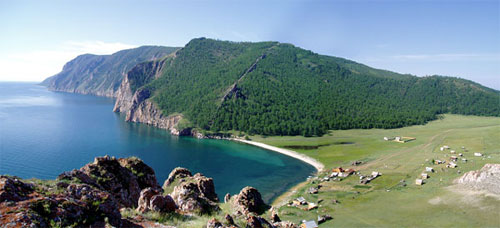
Baikal Magneto-Telluric Observatory. Olkhon Island. Uzury.
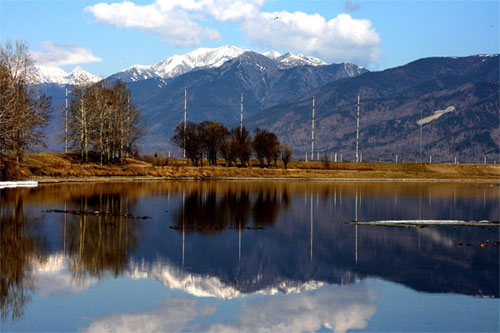
Antennas. Geophysical Observatory. Tory.
The location of the Institute in the East-Siberian region, i.e. Russia’s geographical center, is highly advantageous as regards observational parameters and is important for obtaining helio-geophysical data and for space environment monitoring.
The Institute’s observatories are equipped with observation facilities and complexes, permitting state-of-science observations along the major avenues of inquiry:
– Large Solar Vacuum Telescope ( village of Listvyanka, Irkutsk oblast). LSVT is included on the “List of “Unique Experimental Devices of National Significance Requiring Additional State Support From RF”, No. 01-29. The telescope is designed for high spatial resolution observations of the structure of the solar atmosphere.
– Automated Solar Telescope, permitting spectral observations of solar active features and dynamical processes in the solar atmosphere ( village of Mondy, Republic of Buryatia).
– Large Coronograph to study fine structure and dynamics of the solar chromosphere and corona ( village of Mondy, Republic of Buryatia).
– Solar Telescope for Operative Prediction to measure weak background magnetic fields on the Sun ( village of Mondy, Republic of Buryatia).
– Infrared telescope AZT-33IK ( village of Mondy, Republic of Buryatia). The telescope is designed to study cosmic sources of thermal radiation within the temperature range 300-3000° K (relatively cold stars, stars with dust shells, big planets and planetoids, and interstellar galactic material in regions of active star formation), determine characteristics of asteroids and comets approaching the Earth, observe artificial celestial bodies, and to determine their state.
– Siberian Solar Radio Telescope ( village of Badary, Republic of Buryatia). SSRT is included on the “List of unique experimental facilities of national significance requiring state support”, No. 01-27. The telescope is used to carry out a routine all-weather monitoring of solar activity in the microwave range with high spatial resolution.
– Irkutsk Incoherent Scatter Radar (town of Usolye-Sibirskoe, Irkutsk oblast). IISR is included on the “List of unique experimental facilities of national significance requiring state support”, No. 01-28. The telescope is designed to probe the ionosphere and neutral atmosphere using the incoherent scatter method in the height range 150–1000 km, monitor spacecraft flights, and to study effects from operating rocket engines on ionospheric plasma conditions.
– Multiposition Chirp Ionosonde for vertical and oblique-incidence sounding. The transmitting stations of the ionosonde are located near Magadan, Khabarovsk, Norilsk and Usolye-Sibirskoe. The receiving stations are located near the village of Tory ( Republic of Buryatia) and at Irkutsk. Registration of HF signals along the radio paths (120–3000 km) permits a regular monitoring of ionospheric conditions over a vast spatial region of Russia (within the longitudinal sector 90–150 E), and a study of the ionospheric plasma dynamics in this region during geomagnetic disturbances, extreme atmospheric events (sudden stratospheric warming, cyclones, etc.) and seismic events.
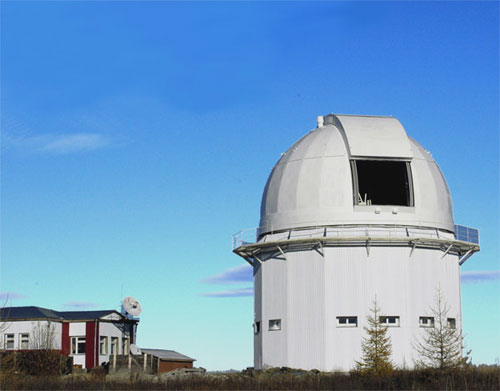
Infrared Telescope AZT33-IK. Sayan Solar Observatory.
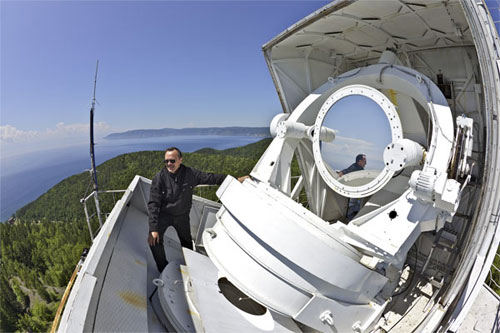
Large Solar Vacuum Telescope. Baikal Astrophysical Observatory. Listvyanka.
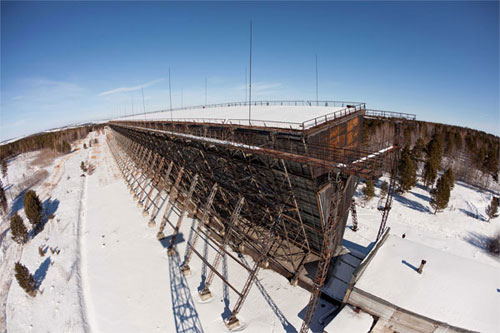
Irkutsk Incoherent Scatter Radar. Atmosphere Radio Diagnostics Observatory.
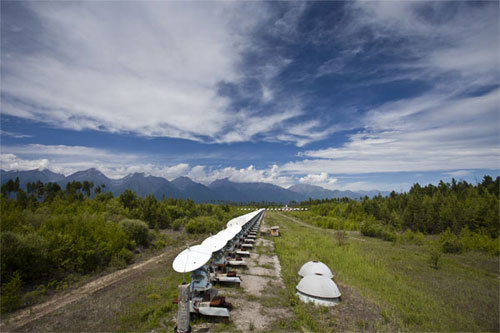
Siberian Solar Radio Telescope. Radio Astrophysical Observatory. Badary.
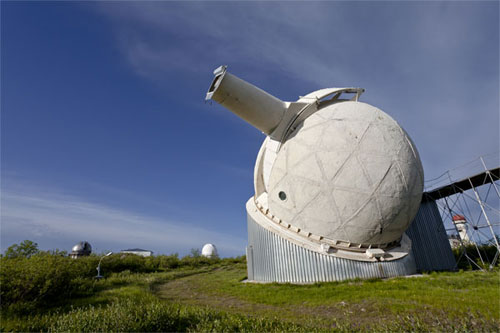
Large Solar Coronograph. Sayan Solar Observatory.
The Institute provides the country’s forecasting centers with real-time data on the Sun, ionosphere and the Earth’s magnetic field.
The unique facilities are advantageously used in implementing basic research programs of SB RAS and RAS, integration and multi-disciplinary projects, pilot projects of RFBR as well as in doing applied research for Roscosmos (Russian Federal Space Agency), Rosgidromet (Russian Federal Agency for Hydrometeorology and Environmental Monitoring), the Ministry of Defense, and other agencies in order to ensure reliable operation of spacecraft, geospace monitoring, operation of complex communication systems, radio location and navigation systems. Besides, the facilities are employed for solving problems of anthropogenic pollution geospace, asteroid hazards and practical ecology.
ISTP SB RAS operates the Space Monitoring Center (SMC) which receives and processes NOAA weather satellite data on the Earth’s surface and atmosphere with the purpose of monitoring the environmental conditions and natural resources of East Siberia, including satellite-based forest-fire detection and monitoring as well as devising novel technologies of promptly responding to fire-hazardous situations on the territory of Irkutsk oblast.
The Institute participates in almost all international projects and programs in solar-terrestrial physics, has agreements with research teams from the USA, Germany, Great Britain, France, Sweden, Spain, Greece, Japan, and other countries. In December 2000, the Institute and the Center for Space Science and Applied Research, Chinese Academy of Sciences (CSSAR CAS), established the Russian-Chinese Joint Research Center on Space Weather. Within the scope of the Center’s areas of collaboration, conferences are held on a regular basis to discuss results of joint research on space weather issues.
The Institute and its staff members received the highest recognition of their merits in the form of government awards. In 1986, the Institute was awarded the Order of the Red Banner of Labor for a further development of physical science, creating the state-of-the-art observation facilities and making a valuable contribution toward solving important national tasks. In 1996, the RF Government Award for Science and Engineering was conferred to the originators of the Siberian Solar Radio Telescope.
The Institute’s staff is about 500 employees, including more than 140 researchers: one Academician, two Corresponding Members of RAS, more than 30 Doctors of Science, about 80 Candidates of Science, and more than 50 young researchers and postgraduate students.