THE SIBERIAN BRANCH OF THE RUSSIAN ACADEMY OF SCIENCES
THE IRKUTSK SCIENTIFIC CENTER


A.P. VINOGRADOV INSTITUTE OF GEOCHEMISTRY SB RAS

1a Favorsky St., Irkutsk, 664033, Russia
Tel.: (3952) 42-65-00, Fax: (3952) 42-70-50
e-mail: dir@igc.irk.ru, www.igc.irk.ru
Vladislav S. Shatsky
The Institute of Geochemistry (IGC) was established on November 29, 1957.
From 1961 to 1988, the IGC was headed by Academician L.V. Tauson, the first Director of the IGC.
From 1988 to 2012 the IGC was headed by Academician M.I. Kuzmin
Major research areas:
- Earth structure, dynamics and evolution of geological and geochemical processes in the history of the Earth: chemical geodynamics, magmatism, metamorphism, and ore formation in different geodynamic settings;
- Global changes of environment and climate: environmental geochemistry, analytical control and paleoclimatology; and
- Production of new materials for solid state electronics, medicine, and ecology.
The research pursued by the Institute has an original nature and is of significant importance for the advancement of geology and related sciences.
The Institute's scientists have established that a large-scale intraplate magmatism originating from mantle sources, was evolving within the Siberian continent during the whole Phanerozoic. The largest magmatic activity occurred at the Permo-Triassic boundary ( ~ 250 Ma). A gigantic volume of basaltic magma (1,5х106 км3) erupted during ~ 1 Myr indicating superplume upwelling to the lithosphere in the area of the present day Icelandic hot spot in the vicinity of which the Siberian continent was located at that time. The analysis of the geological evolution of Siberia indicated that both the processes related to the boundaries of lithosphere plates and the activity of superplumes responsible for the intraplate activity within recent continents have to be considered for paleoreconstructions.
The geochemical features of metamorphic complexes were explored within the Siberian Craton margins and geodynamic settings of formation of terrain protoliths were identified.
Using the obtained isotope-geochemical systematics of kimberlites from the Yakutian province, mineralogical classification of kimberlite pipes from different fields and isotope-geochemical data of mineral megacrysts association the scientists of the institute proposed a new model of kimberlite pipes formation that distinguishes them as channels of the astenosphere fluid uplift to the Earth’s surface.
On a basis of the classification of the East-Sayan nickel-bearing province it was found that Cu-Ni deposits and occurrences are confined to the dunite-peridotite-pyroxenite and plagioperidotite-gabbro-norite rocks.

Fig.1 Mongolia, Central Gobi, Baidrin-Gol river (altitude ~ 2000 m)
The geochemical features and conditions of emplacement of different types of svyatonosites (andradite syenites) were established for the Baikal province. Geochemical characteristics were determined in uneven-aged granitoids (their ore-bearing types included), which formed in different geodynamic settings. 3 new minerals have been discovered in alkaline granites of the Khan-Bogda massif: Armstrongite (Arm), Mongolite (Mong), Kovalenkoite (Kov) (Fig.2). Based on a great number of Sr, Nd, Pb, C and O isotope data the researchers of the institute have recognized 3 sources of forming deep-seated (mantle) alkaline complexes in Siberia as well as specific features of their ore potential.

Fig. 2. New minerals: Armstrongite (Arm), Mongolite (Mong) and Kovalenkoite (Kov)
The research results on pegmatite systems in the regions of the Eastern Siberia were summarized in a monographic series entitled «Granitic Pegmatites».
Based on the plate tectonics concept and large-scale geochemical survey, a classification and summarization of geological and mineralogical-geochemical data, it was found that gold ore deposits in the Transbaikalia, constituting the main industrial capacity of the Chita region, developed mainly in two stages: (i) Middle-Late Jurassic collision, and (ii) Early Cretaceous, rifting, controlled by the Mongolian-Okhotsk suture, the zone of collision of the Siberian and Mongol-Chinese continents. Besides, for the Transbaikalia the gold ore deposits were classified, and geologo-geochemical models of chamber-domal and chamber-depression ore magmatic systems were produced. The multi-reservoir thermodynamic model was calculated for the volcanogenic-hydrothermal ore-forming system of epithermal Au-Ag deposits formed under conditions of active continental margin of northeastern Asia. The theory of formation of geochemical fields at different hierarchical levels was developed to form the basis for the state-of-the-art methodology of prospecting deposits of gold, base metals, rare metals, and unconventional ore types. The results of investigations were summarized in a monograph “Gold-Bearing Ore Magmatic Systems in the Transbaikalia” and “Geochemistry and settings of formation of gold-silver ore systems of the Northern Okhotsk Region”.
The chain of retrospective-geological events was reconstructed for the development of the Bodaibo gold-bearing region since the time of emplacement of Neo-Proterozoic paleo-basin of carbonaceous sediment genesis, and formation of specific sediments to transformation of metaliferous deposits in the processes of catagenesis and metamorphism into gold ore deposits of Sukhoy Log type.
The scientists of the Institute continue comprehensive geological-geochemical prospecting and studies of the super-pure quartz raw material aimed at its application for solar power generation. In 1998 the scientists of the institute discovered a large deposit of super-pure quartzites in the Eastern Sayan mountains.
A new interdisciplinary direction of research on «Regional geochemistry of environment» was initiated. In the Baikal region, 15-year-long observations were used to systematize the data on the distribution of bioactive chemical priority elements; a monograph entitled “Regional geochemistry of the environment of Baikal Region (Baikal geoecological polygon)” was published. The correlations of ecotoxicants (Hg, Pb, Be, Zn, Cu, As, Cd, Mo, U, Co, Ni, S, F etc.) were found for the “snow cover-soil-water-plats-foodstuff-human’s biosubstrata” system in natural and technogenic landscapes of the Baikal Region. The maps of toxic elements distribution in the soil of Irkutsk and Cheremkhovo cities and their environs have been produced. The polluted sites have been recognized within the cities. Geochemical studies have been done for routes and exploration sites of gas-and oil pipelines of the Kovykta and Verkhne-Chonsk deposits.
The information databases on all aspects of geochemical research have been generated and are being constantly complemented, thus providing the basis for the development of GIS projects.
The Institute has the research laboratory located on the north-east of Lake Hovsgol ( Mongolia). This laboratory is the basis for conducting winder drilling operations from ice and summer geological fieldworks. The collected samples can be studied on the site. Long-term observations to study long range transport of POPs (Persistent Organic Pollutants) and seasonal changes of the water composition are pursued in the northern Mongolia. The premises and facilities here provide possibilities to hold small seminars and workshops.


Fig. 3. Research laboratory in Khankh settlement ( Mongolia)
The Institute continues comprehensive studies of sediments obtained in terms of the international “Baikal Drilling Project”. The monograph entitled “Centric diatoms in Lake Baikal during the Late Cenozoic: morphology, systematics, stratigraphy and stages of development (based on the deep cores of the Lake Baikal Drilling Project)” was published. It discusses the change in diatom species and genera in 600-m drill core. It was found that the time of extinction of the majority of diatom species in the lake coincides with onset of glacial periods. The extinction of species in glacials made room for new ecological niches in the lake which were gradually occupied by new species. A close association between climate and speciation is evident.
A continuous relatively high temporal resolution and reliable radiocarbon-dated record that helps to reconstruct the dynamics of landscapes and climate was for the first time obtained for the Eastern Siberia for the last 48 kyr from Kotokel lake (satellite of Lake Baikal). It enables the comparison with the reference paleoclimatic archives representing the North Atlantic (Fig.4). This comparison suggests that the reconstructed changes in the Late Pleistocene and Holocene environment and climate in the Baikal region could have been controlled by the same major factors controlling the climate in the Northern Hemisphere. The correspondence between the records of the regional climate and very high-resolution records from fat distant Northern Atlantic implies that the south of the Eastern Siberia despite its location in the interior of Eurasia responded swiftly to global changes. This conclusion is a key point in the ongoing debate on synchronous/non-synchronous response of terrestrial environments to global changes. Moreover, in the current absence of better-resolved and dated sequences the record from Kotokel lake may serve as a regional stratotype section.

Fig 4. Comparison of the ?18O records from Greenland as indicator of the Northern Hemisphere air temperature (after Svensoon et al., 2008) and landscape dynamics from Kotokel Lake catchment area. In the column Dynamic of landscapes green color means forest, blue- tundra, red – steppe landscapes. LGM - Last Glacial Maximum. LGM – максимум последнего оледенения. MIS 3-MIS 1 – Marine Isotope stages. T I – Last transitional period последний переходный период.
Experimental and theoretical examination of heterogeneous equilibriums and behavior of microelements in geochemical systems with real crystals of phases received the Vernadsky Prize for 2002. Scanning microprobe microscopy and spectroscopy of the nanostructure surface and chemical composition of the surface of some geochemically important minerals revealed the formation mechanism for surface non-autonomous phases, enabling them to be used as indicators of geochemical processes.
A new phenomenon i.e. concentration of trace elements during endogenous processes as a result of their entrance into non-autonomous phases has been discovered. A new field of research of genetic mineralogy – typomorphism and typochemism of mineral surfaces has been introduced.
The processes occurring in the crystals of alkali-earth fluorides with impurity defects that can be used for developing effective scintillators are studied.
Works are being continued on the development of a fundamentally new technology of direct production of solar multi-silicon from refined metallurgical silicon derived from high-purity quartzites from the Eastern Siberia.
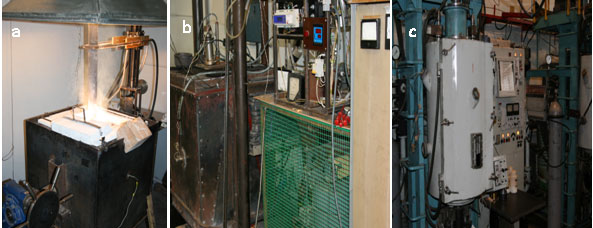
Fig. 5. A laboratory experimental site
A laboratory experimental site (Fig.5), consisting of electric-arc system (on the left), high-temperature furnace (in the middle) and reconstructed industrial system CZVN-20 (on the right) was set up to produce multi-silicon. Experimental and theoretical examinations were made to study the influence of intergranular boundaries on the electric properties of silicon.
At the department of radiation physics the researchers produced thermal-luminescent detector for which they received the RF Government Prize for year 2004. The Irkutsk Governor Prize was awarded in 2006 for the development of technology for producing silicon for solar power generation.
The theory of computer simulation of physico-chemical processes in natural and technogenic systems was developed, based on minimizing thermodynamic potentials using convex programming techniques. The suggested approach provides a means of calculating a complete and/or metastable equilibrium in multi-component, heterogeneous, multi-phase and multi-aggregate models of complex natural objects. The algorithmic and thermodynamic-informational software for physico-chemical modeling was implemented using the “Selector” software package (SP) that is widely used in Russia and abroad. The SP is designed for a broad gamut of problems in the Earth sciences as well as of problems in other areas of application of chemical thermodynamics (environmental protection, fuel-energy systems, pyro- and hydro-metallurgy, chemical-technological processes, etc.). The “Selector” SP has been used to solve important scientific problems: (1) thermodynamic stability of hydrocarbons in the Earth's crust and upper mantle, (2) new approach in geothermobarometry, (3) methodology for modeling hydrothermal deposits, (4) methods for purification of emissions and wastewater from technological production facilities. This PC is widely used in scientific education courses of Russia's establishments of higher education.
Over the course of the fifty four years of its existence, the A.P. Vinogradov Institute of Geochemistry SB RAS has formed East Siberia's largest highly skilled analytical staff doing basic and applied research of the highest international standards in the field of Earth sciences, and on the environmental issues. Locally developed methods furnish a means of analyzing natural and drinking water for 62 chemical elements as well as for the contents of volatile phenols and petroleum products; soils and bottom sediments for 44 chemical elements; rocks for 38 elements; and silicon production for 20 elements. The analysis techniques are all certified (Certificate of the Federal Agency on Technical Regulation and Metrology of Russia (Gosstandard of Russia) on certification of the analytical laboratory (center) No. ROSS.0001.513593). In all the aforementioned natural environments, it is possible to investigate the isotope composition of Sr, Nd, and Pb; work is being underway in the field of Rb-Sr isotope dating.