THE SIBERIAN BRANCH OF THE RUSSIAN ACADEMY OF SCIENCES
THE IRKUTSK SCIENTIFIC CENTER

IRKUTSK BRANCH OF THE INSTITUTE OF LASER PHYSICS SB RAS
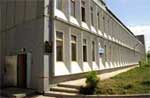
130 a Lermontov St., Irkutsk, 664033, Russia
Tel.: (395-2) 51-21-60, 51-14-38, Fax: (395-2) 51-21-60
e-mail: filial@ilph.irk.ru
The Branch is headed by Doctor of Physical and Mathematical Sciences, Professor Evgeniy Fedorovich Martynovich.
The Irkutsk Branch of the Institute of Laser Physics SB RAS (Branch) was established on the basis of the Automation and Technical Physics Department at the SB RAS ISC Presidium by the order of the Director of the Institute of Laser Physics SB RAS academician S.N. Bagayev, based on the decision of the SB RAS Presidium.
The Branch is engaged in the solution of fundamental and applied problems in laser physics. In this field of physics, the interaction of light and matter is investigated. Laser facilities have undergone significant development after starting the first laser in 1960. Record-breaking high energy flux densities, superstrong electric fields, ultrahigh pressures and powers, and ultrashort durations of energy effects, which are unattainable by other methods, have been achieved. Under extreme conditions of light and matter interaction, new, previously unknown, phenomena are realized and studied.
The Branch consists of the Laboratory of Laser Systems and Technologies, the Laboratory of Photophysics of Condensed Media, and the Electronics Group. The Branch has a good combination of highly experienced and young professional personnel, and provides post-graduate education in three specialties: laser physics, optics, and physics of condensed state. The Branch participates in the arrangement of scientific schools, seminars, and conferences. The International Workshop on Luminescence and Laser Physics has become a tradition; it is hosted by the Branch in collaboration with Irkutsk State University, Irkutsk Scientific Center SB RAS and the Institute of Geochemistry SB RAS. The Workshop was pioneered by the Honored Scientist of the Russian Federation, Professor I.A. Parfianovich. To date it is held under the auspices of Academician S.N. Bagayev, Chairman of the Scientific Council of RAS on optics and laser physics, and Professor A.G.Vitukhnovsky, Chairman of the Scientific Council of RAS on fluorescence.
Staff members of the Branch work in Dissertation Councils, are members of the Collegium of National Experts in lasers and laser technologies, are entered in the Federal Register of experts in the field of science and technology, are regularly invited to be peer-reviewers of contributions submitted to international scientific journals and to be editors of collections of scientific papers, and participate in the competition and expert councils at Irkutsk Oblast Administration.
Research cooperation with universities and the Russian Academy of Sciences’ institutes is getting under way. Staff members of the Branch render methodological and practical assistance to the region's institutions, enterprises and organizations in the implementation of laser technologies in research, education, industries, and medicine.
Next, we highlight the most important scientific achievements. Our studies revealed the mechanisms and determined the parameters of longitudinal spatial selectivity of the action of coherent pairs of opposing as well as overtaking femtosecond laser radiation pulses on optical media of different symmetry. It was demonstrated that the detected influence of the interference interaction of traveling polarization wave packets induced on quantum systems of definite orientations can be used in accomplishing longitudinal selectivity of a nano-dimensional scale. Fundamentally new methods of holographic subtraction of images with spatial filtering have been suggested; they provide high quality of the holographic image. The thermochemical mechanism of formation of nanothick films on the surface of activated dielectric crystals was unraveled. The properties of single molecules, nanoparticles and point defects at baseplates and in materials, and the kinetics of motion and transformation of these objects are investigated. The optical method for determination of orientation of a single quantum system in arbitrary transparent media (for example, single impurity molecule or point defect in glass or crystal) has been developed. The previously known methods, as developed by S.I. Vavilov, P.P. Feofilov, and other authors, allowed us to find the orientation of assemblies of a large number of quantum systems in crystals of certain symmetry. The method for measurement of ultra-low concentration of impurities in transparent media, based on optical registration of single molecules, has been developed. Research cooperation with Irkutsk State University led to the development of the automated interferometer designed for precise optical measurements in the femtosecond time range (10 -13–10 -15 s), based on the anisotropic medium of a controlled thickness, and the conditions were determined under which the dispersion of pulses in the optical elements of the interferometer does not distort its readings. New optical multiplex mask spectrometers were invented. The Branch, in collaboration with the Irkutsk Institute of Chemistry SB RAS, pioneered the creation of nonlinear optical media on the basis of organic phosphorus compounds and developed a variety of acceleration techniques for chemical reactions, based on powerful pulsed optical and ultraviolet radiation sources as well as with the use of x-ray radiation.
Currently the time effects of interaction of femtosecond laser irradiation and transparent dielectrics are being investigated: self-focusing, filamentation, generation of white light, forming of point structure defects, and others. These effects are studied with single pulses, that is, in the elementary conditions, in contrast to studies of other research groups. Based on this, it was experimentally proved for the first time that the mechanism of moving nonlinear focuses due to variation of light power during pulse is the primary mechanism of filamentation of femtosecond laser irradiation in solid transparent dielectrics. The formation of filaments, reported in earlier work, is determined by secondary effects only, which are associated with changes in the properties of material during irradiation with a large number of pulses. It was shown for the first time that the effectiveness of creation of radiation defects in wide band-gap crystals with a femtosecond laser is in large excess over the effectiveness of x-ray and isotope gamma-ray facilities, linear electron accelerators and even high-current electron accelerators. On the basis of the phenomenon of point defects formation in materials under the laser light action, new methods of ultra-dense multilayer optical writing of information are developed. The first successful experiments of multilayer writing of information in the volume of crystalline media have been carried out on the basis of fluorescent defects formation under the action of femtosecond laser irradiation.
The Branch designs and produces electro-optical devices: diode lasers, solid-state lasers with diode pumping; programmed power supplies; software-driven laser engravers; fluorescence spectrometers for study, detection, identification and analysis of substances; modern photoreceivers; systems for simple and time-correlated photon counting; sources of UV, visible and IR light, and education aids for laboratory practice. The vibration monitoring instruments for full-scale plants that have been developed and manufactured by the Branch, are being used in the Irkutsk aluminum smelter and the silicon plant in Shelekhov, in diamond-mining enterprises in the Sakha (Yakutia) Republic, and in the petrochemical plants in the city of Angarsk. Research and engineering work is being carried out with the purpose of developing optical methods for detection and identification of diamonds and other matter. A demonstration working prototype of the instrument for non-contacting determination of ethanol percentage in alcohol products has been built. The Branch also gained wide experience in the creation of single-crystal and nanostructured ceramic laser materials and fluorescent materials, laser elements and shutters, and nonlinear optical memory media. Laser technologies of materials processing are developed on requests: laser cutting of sheet metal, inverse engraving of metallized glass, and others.
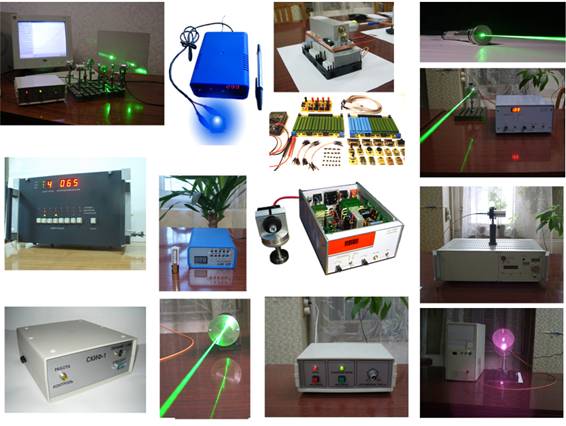
Some products from applied research, as made by researchers of the Branch
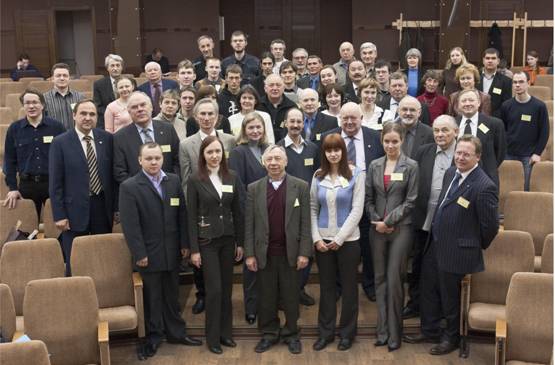
Participants of the 11 th International Workshop on Luminescence and Laser Physics, which was hosted by the Branch.