THE SIBERIAN BRANCH OF THE RUSSIAN ACADEMY OF SCIENCES
THE IRKUTSK SCIENTIFIC CENTER


INSTITUTE OF THE EARTH CRUST SB RAS
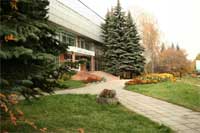
128 Lermontov St., Irkutsk, 664033, Russia
Tel.: (3952) 42-70-00, Fax: (395-2) 42-70-00, 42-69-00
e-mail: drf@crust.irk.ru, www.crust.irk.ru
Doctor of Geology and Mineralogy.
The Institute was founded in 1949 as the Geological Institute and was renamed in 1962.
Directors:
1949-1952 – N.A. Florensov, Corresponding Member of the USSR Academy of Sciences;
1953-1954 – acting director Е.К. Grechischev, Candidate of Technical Science;
1954-1976 – M.M. Odintsov, Corresponding Member of the USSR Academy of Sciences;
1976-1998 – N.A. Logatchev, Academician of RAS.
1998-2011 - Evgeniy V. Sklyarov,
Corresponding Member of RAS
The Institute of the Earth’s Crust, originally named the Institute of Geology, East-Siberian Branch of the USSR Academy of Sciences, emerged in Irkutsk in February 1949 according to USSR Council of Ministers Decree No. 1138-r of February 1, 1949, and USSR Academy of Sciences Presidium Decree No. 3, § 8 of February 24, 1949 concurrent with the foundation of the Branch. It was renamed to the East-Siberian Geological Institute in 1957; in 1962, it came to be known as the Institute of the Earth’s Crust SB AS USSR and adopted its present name in 1992.
The Institute of the Earth’s Crust is a comprehensive scientific institution doing research along the unique avenues of inquiry. The focus areas of the Institute's research are as follows.
- Recent endo- and exogeodynamics. Geological medium and seismic process. Resources and dynamics of underground waters and geoecology.
- Internal structure, paleogeodynamics, endogenous processes, and fluid dynamics of the continental lithosphere.
In line with these areas of research, the Institute has three sections: Geology, Geophysics and Recent Geodynamics, and Hydrogeology and Engineering Geology. These sections include, respectively, seven, six and two laboratories.
The Institute consists of skilled, highly experienced researchers; among them are one academician, one corresponding member of RAS, and 29 Doctors and 66 Candidates of Science, among which are 11 research professors. The Institute consists of 15 subdivisions, the total number of the staff members being 298.
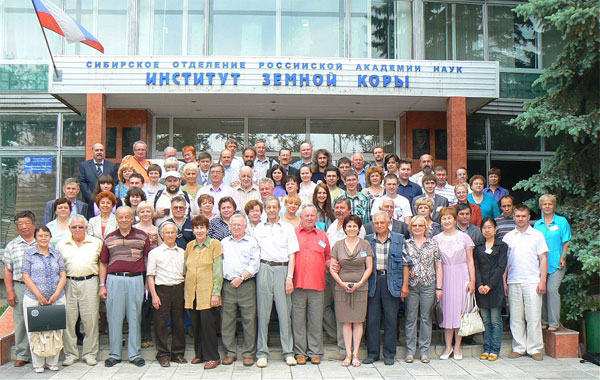
The Institute boasts proven leadership as regards the study of continental rifting. Its researchers have elucidated the main structural and evolutional trends in the Earth’s continental rift zones using Eurasia, East Africa and North America as an example and created a complex geodynamical model of the evolution of the Baikal rift zone and adjacent areas, shedding light upon the deep structure of East Siberia and Mongolia. A number of recent Russian-Mongolian transects have been designed to gain a more penetrating insight into tectonic structure throughout the entire width of the Earth’s crust, or plate tectonics. The existence of anomalous (low-velocity) mantle area beneath the Baikal rift zone has been suggested, based on evidence derived from the joint Russian-American study under the "Teleseismic tomography of the Baikal rift mantle" project.
The Institute’s researchers have put forward a hypothesis for diamond prospectingand made a prognostic evaluation of the diamond-bearing properties in the southern Siberian Platform. They have compiled a structural map of the ancient basement underneath, and a prognostic map of diamond prospecting in Irkutsk oblast.
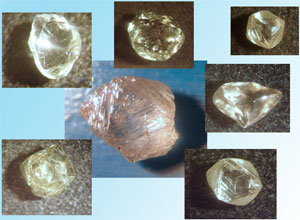
Diamonds of Irkutsk region
Studies have been made on the crustal composition, structure and geodynamics of East Siberia, trends of sedimentation, magmatism and rock metamorphism, and associated mineral deposit formation. A number of new ore-bearing structures and deposits have been discovered. It has been confirmed that metamorphism can exert some effect on gold mineralization. This work has resulted in the discovery of lode deposits (Sukhoi Log). A study is being conducted with lithology and stratigraphy of the continental sediments and weathering crusts. The fluid simulation has been performed for rock and ore formation in the crust and upper mantle, and an estimate was made of the energy response of fluid mass transfer at the scale of the lithosphere and to that of fluid components in the continental and oceanic lithospheres in the 200-km interval to the surface. The researchers of the Institute have discovered more than 15 new minerals, including rock-forming minerals belonging in the groups of pyroxenes, spinels, micas and tourmalines, named after the leading scientists of the Institute or remarkable events in the Institute’s history (odintsovite, florensovite, nataliite, zemkorite, azoproite, and others).
An integrated geophysical interpretation provided the reconstruction of deep-seated thrust zones extending over a few hundred kilometers in the south of East Siberia and Mongolia. Evidence has been obtained for the plume stems associated with the Late Cenozoic alkaline basalts.
The term "integral indicator of the lithosphere geodynamics" has been coined to evaluate geodynamic activity of the continental lithosphere. Experimental and field studies are being conducted on faulting in the lithosphere.
The Early Paleozoic collision belt of high-grade metamorphic rocks from the Slyudyanka and Olkhon complexes and Kitoikin zone has been found in the mountains of Pribaikalye framing the Siberian craton on the south.
The craton margin has been viewed as a seat of dikes cropping out in a broad belt extending over the Biryusa, Sharyzhalgai and Northern Cisbaikalia fields, which is probably associated with the decomposition of the Rhodinia Supercontinent.
In Southern Transbaikalia, metamorphic core complexes, associated with the Late Mesozoic large-amplitude intracontinental extension, have been discovered and characterized.
The Institute is a recognized center for research on neotectonics, geomorphology and seismogeology, resulting in the development of the paleo-seismogeological method for estimating seismic risk that finds wide use both in Russia and abroad. This method has provided a basis for a new version of the seismic zoning map of Northern Eurasia and for estimating seismic risk for some major construction projects. Measures are being taken to mitigate earthquake damage, and the regional seismic intensity scale is being proposed with regard to local engineering-geological conditions. Seismic microzoning has been conducted in the permafrost areas.

In 1979, in an effort to extend its research on seismicity of the region, the Institute organized the Baikal Experimental-Methodological Seismological Expedition (the Baikal Branch GS SB RAS since 2004) that carries out a seismic monitoring at 23 stations installed in a high seismicity mountain belt extended from the Eastern Sayan Range to the Olyokma river valley.
The studies of hydrothermal activity in the south of East Siberia and Mongolia have involved compiling heat flow maps, temperature profiling for different horizons of the Earth’s crust, and predicting gas hydrate formation in the sediments of Lake Baikal from the geothermal data available.
In collaboration with the French researchers, the Institute deployed a GPS network to monitor the recent movements of the lithospheric blocks in southern Cisbaikalia, Tansbaikalia area, and Mongolia. The first quantitative data have been obtained on the lithospheric extension to the south-east of the stable Siberian craton.
Systematic studies of underground waters were summarized in the monograph entitled “Fundamentals of Hydrogeology” (a 6-volume set). Also, an estimate was made of the potential use of underground water in water supply systems, heat power industry, medicine, and extraction of dissolved elements. A monitoring of underground waters is being conducted in different parts of East Siberia. Evidence has been obtained for the cause and effect relationship between permafrost and underground hydrosphere formation in the Yakut diamond-bearing province and for morphogenetic diversity of permafrost zone.
Engineering geology data have been collected in the zone of reservoirs of the Angara-Yenisei cascade of hydroelectric stations, the Baikal shore, and the Baikal-Amur Railway. An array of base stations have been deployed to monitor marginal erosion and changes in landscape pattern and engineering-geological properties under the influence of economic development and exogeodynamic processes.
Energetic and bulk properties of some individual gases near the liquid core-mantle boundary were studied for the first time.
Isiotopic-geochemical characteristics (Sm-Nd) have been obtained for peridotite nodules from kimberlites of the northern and central Yakut diamond-bearing province.
Spatiotemporal analysis of magmatic development served as a basis for simulation of a new mechanism for the Late Mesozoic and Cenozoic subduction of oceanic plates under East Asia.
The researchers of the Institute were awarded the state awards for major scientific achievements. In 1980, V.A. Buryak was awarded the Lenin Prize for the investigation of the unique Sukhoi Log gold field. The USSR State Prize in Science and Technology was awarded to N.F. Florensov, N.A. Logatchev and O.M. Adamenko in 1978 for “Relief history of Siberia and the Far East” (a 15-volume set), to E.V. Pinneker and B.I. Pisarsky in 1986 for “Fundamentals of Hydrogeology”(a 6-volume set), and to B.M. Vladimirov in 1991 for “Geology and Genesis of Diamond Deposits” (a 2-volume set). In 1988, A.A. Bukharov, S.I. Golentsky, V.I. Dzhurik, S.M. Zamaraev, N.Ya. Zarubin V.S. Khromovskikh, V.M. Kochetkov, R.A. Kurushin, V.K. Laperdin, N.A. Logatchev, L.A. Misharina, V.V. Nikolaev, V.A. Pavlenov, O.V. Pavlov, E.V. Pinneker, R.M. Semyonov, S.I. Sherman, V.P. Solonenko and V.G. Yasko were awarded the Prize of the USSR Council of Ministers for geological and seismological environment research with regard to the Baikal-Amur Railway construction and publication of “Geology and Seismicity of the BAM Zone” (a 8-volume set). The title of Honored Scientist of the Russian Federation was awarded to S.F. Pavlov (1980), E.V. Pinneker (1992), Yu.A. Zorin (1999), B.I. Pisarsky (1999), and S.I. Sherman (1999). Winners of the Lenin Komsomol Prize are S.V. Lysak (1970) and S.V. Rasskazov (1986). Seven researchers of the Institute were elected members of the USSR or Russian Academy of Sciences: N.F. Florensov (1960), M.M. Odintsov (1964), V.P. Solonenko (1966), N.A. Logatchev (1979), F.A. Letnikov (1987), E.V. Pinneker (1990), and E.V. Sklyarov (1997). The Order of Honor was awarded to F.A. Letnikov (1999) and A.A. Konev (1999), the Order of Friendship of Peoples ? to V.I. Dzhurik (2000), S.V. Lysak (2000) and Yu.B. Trzhtsinskii (2000), the Medal of the Order of Merit for the Fatherland, I class ? to K.G. Levi (2007), and the Medal of the Order of Merit to the Fatherland II class ? to S.B. Brandt (1999), B.M. Vladimirov (1999), K.G. Levi (1999), S.V. Rasskazov (1999), V.V. Ruzhich (1999), V.A. Sankov (1999), Z.F. Ushapovskaya (1999), V.A. Potapov (2003), and E.V. Sklyarov (2008). In 2007, L.Z. Reznitskii, E.V. Sklyarov, Z.F. Ushchapovskaya, A.A. Kashaev and I.G. Barash were awarded a diploma for the discovery and description of the new mineral batisivite V8 Ti6 [Ba(Si2 O)] O28.
The Institute has been and is an active participant of the international geological-geophysical programs sponsored by the International Union of Geodesy and Geophysics (IUGG): Upper Mantle of the Earth (1965–1970), Geodynamic Project (1971–1980), Lithosphere (1981-1999), and International Geological Correlation Program (IGCP) under the auspices and sponsorship of the International Union of Geological Sciences.
The Institute was the central institution for the Russian part of the Soviet-Russian-Mongolian Geophysical Expedition of RAS and MAS whose participants were not only the Russian and Mongolian but also the American and French scientists.
For a time, the Institute was running its International Center for Active Tectonics and Natural Disasters with the participation of scientists from the universities of Belgium, France and Germany, and from the Academy of Geological Sciences of China.
The Institute has two dissertation councils for achieving the academic degree of Doctor of Science: D 003.022.02 (general and regional geology; geotectonics and geodynamics; petrology, volcanology; geophysics and geophysical exploration activities), and D003.022.01 (hydrogeology; engineering geology, permafrost and soil studies).
The Institute hosts two leading scientific schools:
- Endogenous fluid Phanerozoic systems of continental lithosphere of Central Asia (headed by Academician of RAS F.A. Letnikov);
- Petrological indicators of tectonic evolution of ancient cratons and folded areas (headed by Corr Mem of RAS E.V. Sklyarov).
The previously hosted schools were:
- Cenozoic continental rifting (headed by Academician of RAS N.A. Logatchev);
- Role of roundwater in geological processes (headed by Corr Mem of RAS E.V. Pinneker).
The Institute cooperates with some departments of the universities.
Irkutsk State Technical University :
Recent Geodynamics and Natural Disasters;
Applied Geophysics and Geoinformatics;
Irkutsk State University :
Modern Laboratory Investigation on Dynamic and Engineering Geology;
Research and Education Center (REC “Baikal”).
Twice a year the Council of Young Scientists of the Institute holds the All-Russian youth scientific conferences on basic trends in geological-geophysical research into the lithosphere.