THE SIBERIAN BRANCH OF THE RUSSIAN ACADEMY OF SCIENCES
THE IRKUTSK SCIENTIFIC CENTER


BAIKAL MUSEUM ISC SB RAS

1 Akademicheskaya St., Listvyanka, Irkutsk, 664520, Russia
Tel./Fax: (3952) 45-31-45
e-mail: bm@isc.irk.ru
 Director – Candidate of Geographical Science Vladimir A. Fialkov.
The principal scientific mission of the Baikal Museum is to investigate the evolution characteristics of the Lake Baikal ecosystem , with related research done both directly on the lake and in the world’s only aquarium complex consisting of 40 aquariums, which comprises a part of Lake Baikal itself.
Of particular importance is gathering, storage and monographic description of collections of Baikal’s aquatic organisms, systematization and preservation of the gene pool of Baikal’s endemic flora and fauna.
Nowadays the museum holds more than 16 000 representatives of 3350 plant and animal species inhabiting Lake Baikal and the Baikal region. The museum’s staff members are involved in the ongoing process of describing and systematizing the collections.
Since 2007, real-time satellite-based observations of the Baikal seal rookery on one of the Ushkan Islands have been carried out and archived.
A large video archive was compiled, based on underwater investigations using submersible manned vehicles "Pisces" and "Mir" - more than 700 hours of underwater filming at all depths of Lake Baikal, including more than 500 hours in high definition and 60 hours in the 3D-stereo mode.
Another, equally important, task has a scientific and educational nature. The latest results of research in all fields of science on Lake Baikal and its region are kept and displayed as part of the museum’s expositions.
Over the past 17 years the Baikal Museum has been visited by more than 1 million people.
There are seven exhibits in the museum:
1. Central to the Baikal Museum is a living exhibit consisting of 11 large-volume tanks with a unique system of water circulation. Thus the aquarium complex is a part of the lake. The aquarium exhibit details the life of the lake, represented here by 20 species of fish, 5 crustacean species, 3 species of sponges and 2 species of mollusks. Two seals live in the largest aquarium.
2. The virtual dive to the bottom of Lake Baikal, or "Bathyscaph", is the room stylized to appear like a submarine compartment. Such a scientific and educational tour allows you to observe the life of Lake Baikal at maximum depths and feel a real member of the dive. The basis for the project is the original underwater survey and filming carried out during dives in a diving apparatus, "Gammarus", and in deepwater manned submersibles "Pisces-11" and "Mir-2".
3. The flora of the Baikal region is represented as a dendrological exposition that was opened in 2009 on the territory adjacent to the building of the museum and along the Kamenushka river. A special “trail network” was constructed here: the wooden sidewalks with handrails, elevated above the ground (to avoid damage to soil cover and plants), observation decks, and bridges across the stream.
It is a peculiar kind of living exhibition which gives an idea of the flora of the Baikal region, including rare and endangered species. Trees, shrubs, lianas, and herbaceous plants and mushrooms accompanying them are cultivated in open ground. Arboretum covers an area of four hectares with a creek, woods and picturesque steppificated hillside on the lake’s shore. The park's flora includes 236 species of vascular plants from 51 families. Among the flora represented in the dendropark, 16 plant species are protected at the federal and local level, and 42 species are medicinal plants. Every year the collection of living plants is replenished with rare species of the Baikal region.
4. Underwater investigations of Lake Baikal. History and the present.
In 2010, the Baikal Museum opened a new exhibition "Underwater Studies of Lake Baikal. History and the Present. "
Scuba diving equipment and underwater surveys of Lake Baikal began to be used on a regular basis in the early 1960s. In 1974, an experimental hydrochemical study was carried out with unmanned autonomous underwater vehicle "Skat", and for underwater observation and photography at depths of up to 25 m with diving support "Gammarus" of the open type. In 1977, it was for the first time that scientists were able to explore the bottom of Lake Baikal, using the deepwater manned vehicles (Russian acronym – GOA) "Pisces-7" and "Pisces-11."
On August 10, 1977, in Listvenichny Bay, "Pisces-11" reached a depth of 1410 m. In 1990-1991, “Piscis” GOA continued deepwater research into Lake Baikal. On July 28, 1991, scientists descended to the maximum depth of Lake Baikal ( 1637 meters) near Olkhon Island.
During 2008-2010, underwater studies on Lake Baikal were carried out with the help of the "Mir-1" and "Mir-2" GOA.
Several series of dives of deepwater manned submersibles "Pisces", "Mir-1" and "Mir-2" to the bottom of Lake Baikal allowed researchers to detect areas of chemosynthetic life, outcrops of oil and gas (methane) and gasohydrate accumulations, and new biologic species, improve significantly our knowledge of the depth structure of the Baikal depression, and to draw public attention to environmental problems of the lake.
5. Remote monitoring of the Baikal organisms, or seal on-line «Baikal in real time." In collaboration with the Transbaikalian National Park, equipment was installed on the seal-rookeries on the Ushkan Islands. During the summer time, video images of the life of seal are transmitted on-line to the Museum’s building.
6. A new exhibit: "Baikal’s wildlife under a microscope". The program showing living invertebrates and algae which are caught in the coastal zone on a daily basis, has been created. Shellfishes, crustaceans, flat worms, annelids, leeches, chironomids, and other hydrobionts can be watched under microscope. To provide a more detailed theoretical introduction to a variety of hydrobionts, special videos were produced and a 10-minute-long presentation prepared.
7. A new exhibition of the Baikal Museum, "The development of life in the process of abiotic changes on Earth" which shows the evolution of the Earth from the 'Big Bang' to the present day, including details about the history of the origin and existence of Lake Baikal. The display uses the latest methods of demonstration: multimedia, holographic images, and observations in real time. The observations in real time allow visitors to see the protected wilderness areas and their inhabitants in any season. Hence, it is possible to monitor continuously Baikal organisms and environmental conditions. Particular attention is paid to the Baikal seal: elucidation of the biology of this species, and assessment of population and its distribution in the waters of Lake Baikal.
In 2008, the Baikal Museum, with support from the “V.I.Vernadsky Fund” and LLC "Gazprom Mining Irkutsk", set up the Environmental Education Center. It is a computerized high-tech classroom with 21 training desks with teaching microscopes. Teaching at the Center is a combination of lectures with the study of living organisms of Baikal. It hosts competitions and schools on “Baikalogy”.
The museum is gradually turning into Baikal’s scientific and educational center. The Baikal Environmental School is in operation, and the itinerant exhibition "Visiting grey-haired Baikal" has been arranged; contests, conferences, scientific seminars and competitions in “Baikalogy” are held.

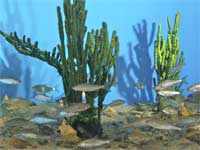
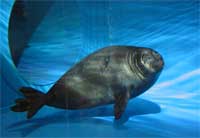
Aquarium's exposition

Museum’s Exposition

Virtual diving to Baikal's bottom

Thermocompressor NT 60-1
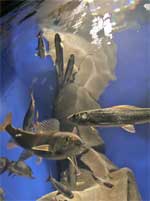
Aquarium's exposition